What Affects Custom Lighting Production Time?
“How long will it take?” is usually the first practical question after a custom-lighting idea begins to feel real. It is also the question that deserves a more honest answer than a fixed number copied onto every project.
A finish change on a familiar frame is not the same job as a large chandelier drawn from a reference image. Ten matching sconces are not planned like a single foyer fixture. Natural stone, handmade glass, new metalwork, project-specific electrical requirements, and difficult packing can each change the schedule.
For that reason, we confirm production time for the actual specification. We do move quickly to arrange production once the design is approved, but speed begins with knowing exactly what is being made.
The schedule starts before the workshop
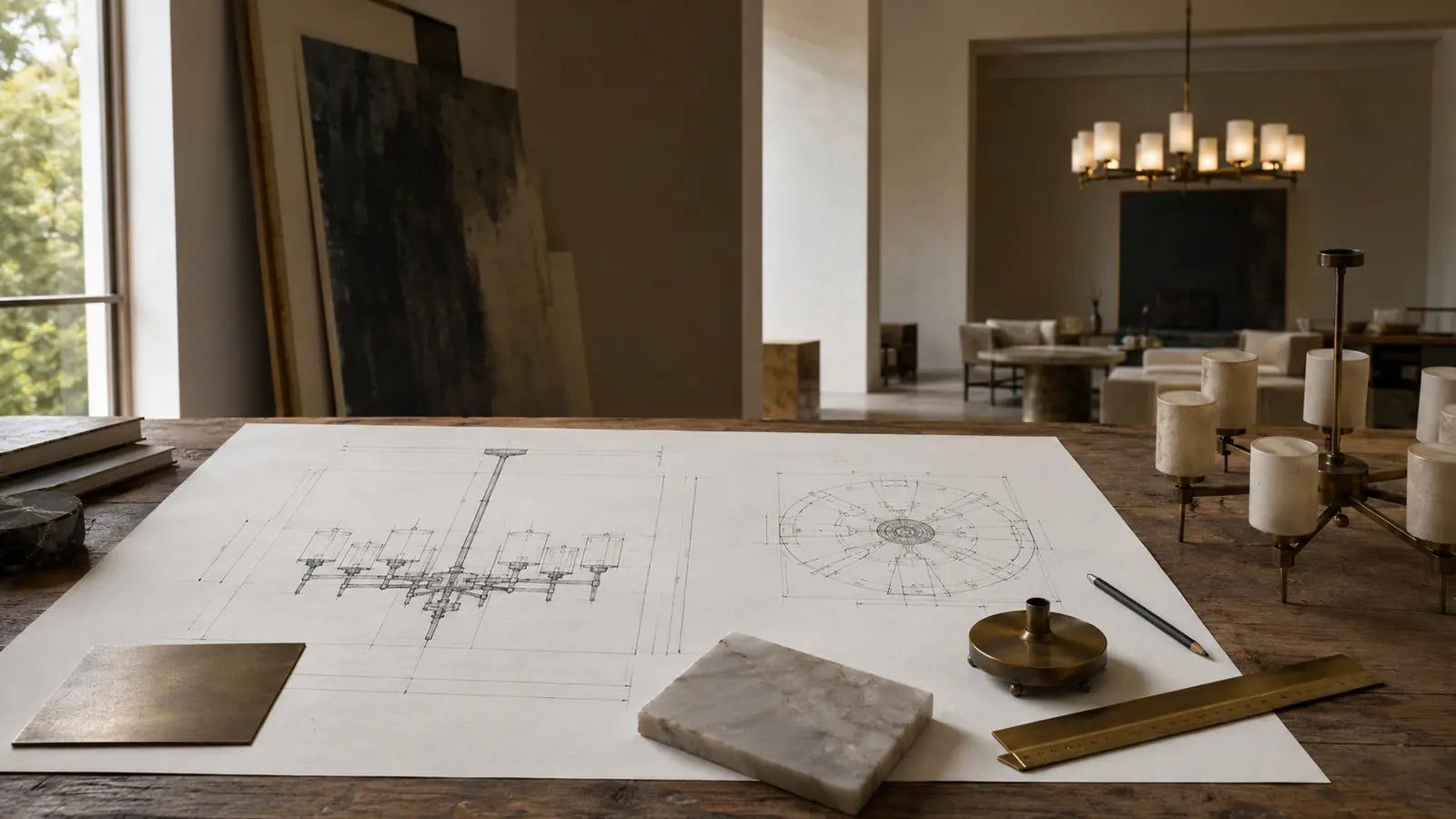
People often think of production time as the days spent cutting, finishing, wiring, and assembling. In practice, a custom project starts earlier—with review, decisions, and drawings.
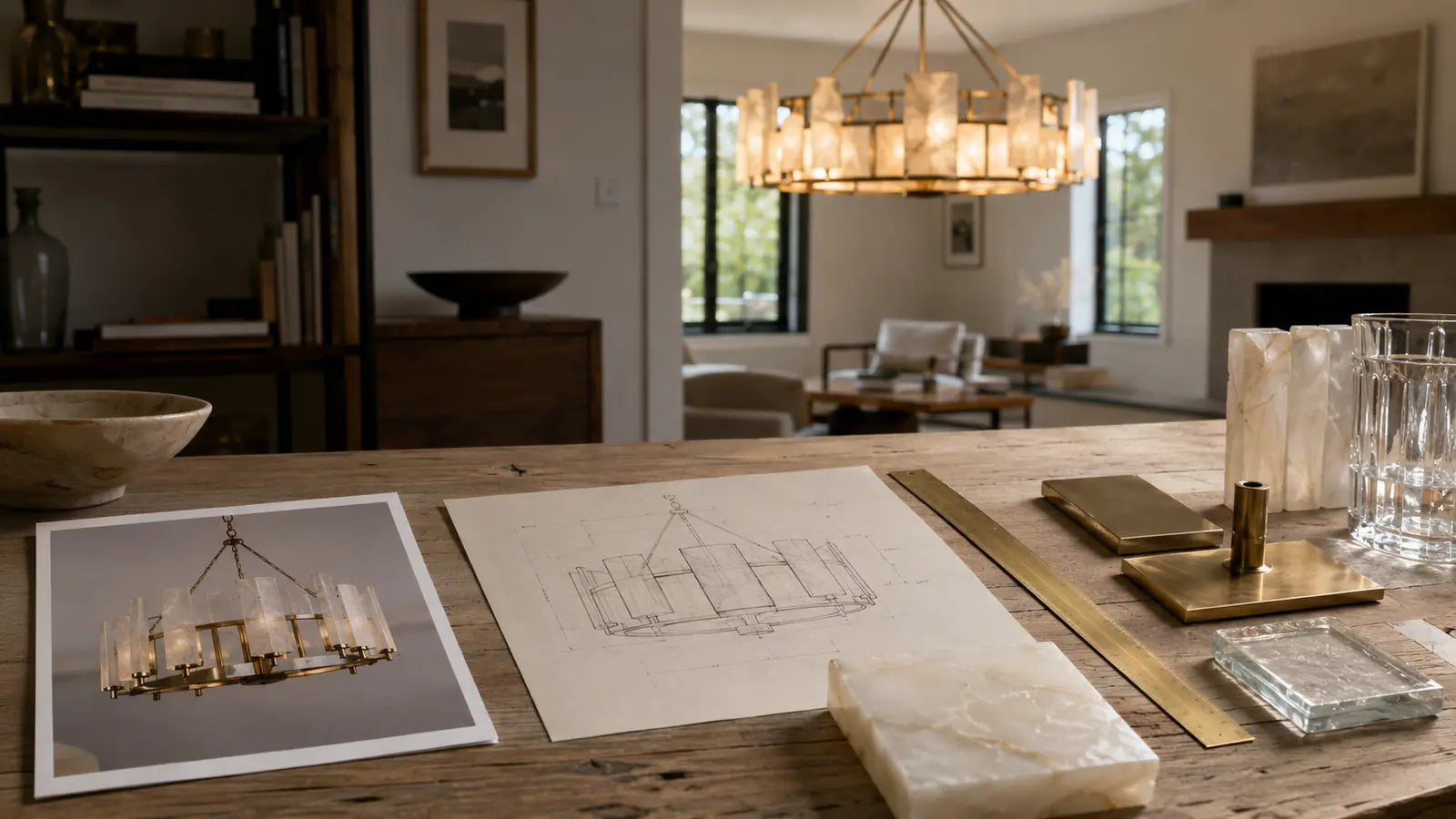
If a customer has a finished drawing, confirmed finish, and clear electrical requirements, that stage can be straightforward. If the starting point is one room photograph and a request to make the fixture “about twice as large,” we first need to resolve proportion, structure, suspension, and installation details. That is design development, not delay.
What most often affects the timeline
1. How complete the design is
An existing fixture with a different drop length may need only a simple confirmation. A new form may require an elevation, plan view, component details, or a second review after dimensions change. Complex work deserves enough drawing time to find problems on paper instead of at the ceiling.
2. Material availability and selection
Metal, common glass, and standard components may be readily available. A particular alabaster tone, unusual crystal size, specialty glass, or tightly matched natural material can take longer to source and sort.
Natural variation is part of the material. If a project calls for very pale stone with minimal veining, or closely matched panels across several fixtures, the selection standard should be agreed before production planning.
3. Finish development
“Brass” is not one finish. It can be brushed, polished, aged, darkened, satin, warm, pale, sealed, or intentionally uneven. A known finish direction is faster to confirm than a custom tone developed from an interior rendering. When a sample is needed, both sample preparation and approval should appear in the schedule.
4. Size, weight, and structure
Increasing diameter does more than enlarge the appearance. It can change frame strength, suspension points, balance, canopy size, wiring routes, assembly method, and crate dimensions. A large fixture may also need to be divided into sections that can pass through a doorway or elevator and be assembled on site.
5. Electrical and control requirements
Voltage, lamp or LED configuration, color temperature, driver location, dimming method, and any project-specific compliance requirement need to be resolved for the final configuration. A late change from a standard bulb arrangement to an integrated dimmable LED system is not a small editorial revision; it can affect several physical parts.
6. Quantity
One fixture and twenty fixtures do not simply take one day and twenty days. Repeated production can be efficient, but material ordering, jigs, finish consistency, inspection, labeling, and packing all have to be planned for the batch.
7. Approval speed
A drawing waiting ten days for review adds ten days to the calendar even though nothing is wrong in the workshop. The same is true when a finish sample is approved, then reopened after other room materials change. We understand that design decisions take time; the important thing is to include that review time in the project plan.
8. Packing and delivery preparation
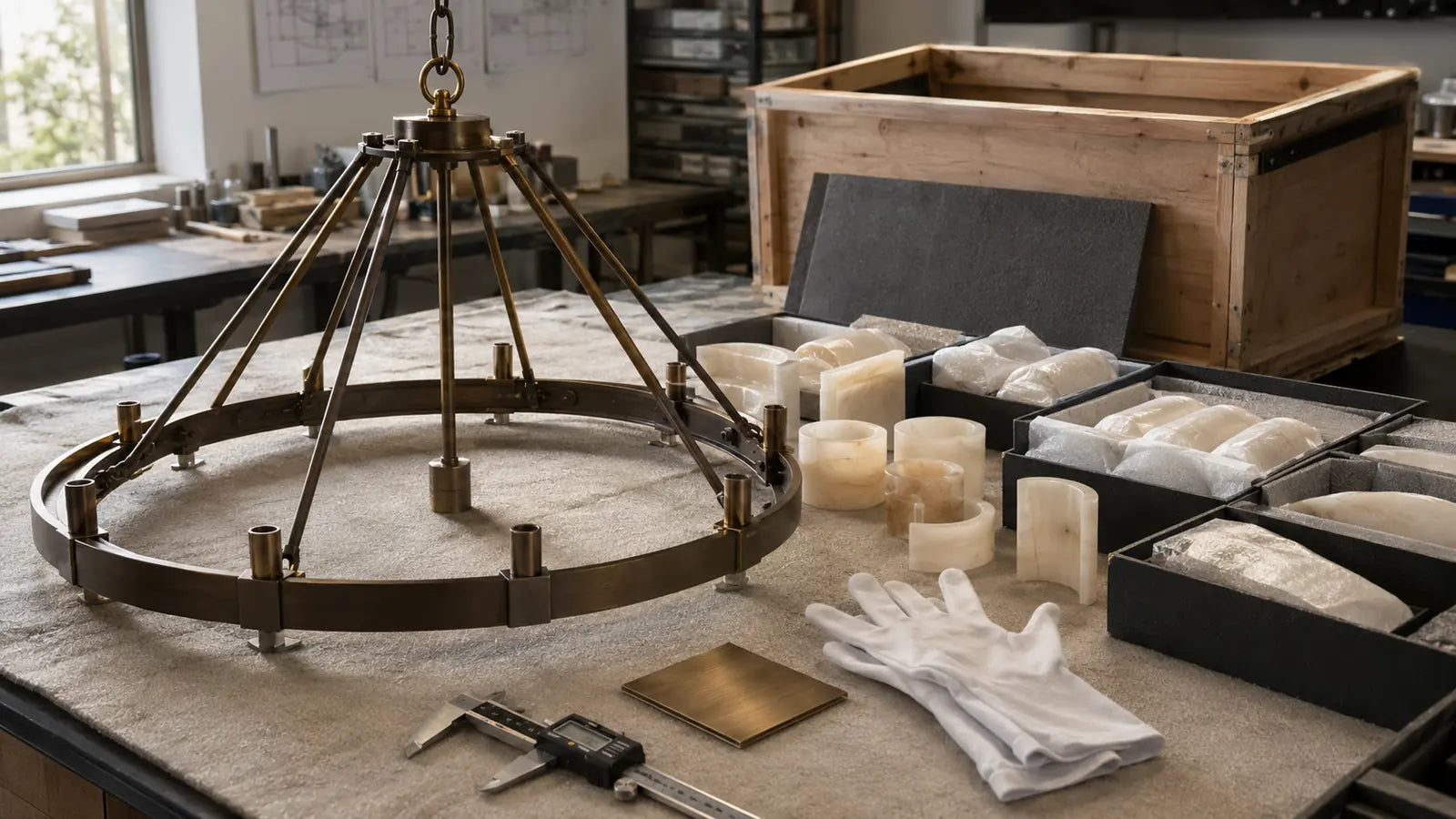
A small assembled pendant may be simple to pack. A delicate chandelier with stone shades, long arms, or individually labeled branches may require a custom crate, separated components, spare parts, and a specific unpacking sequence. Good packing is part of making the light, not an activity added at the loading door.
What helps a project move faster
- Send room dimensions, ceiling height, quantity, destination, and a clear reference at the beginning.
- Identify one person who can confirm design decisions for the project.
- Separate fixed requirements from preferences. “Diameter cannot exceed 48 inches” is different from “we are considering 48 inches.”
- Review the full drawing, not only the overall shape. Check the canopy, drop, finish, light source, and electrical notes.
- Ask the installer to review weight, support, junction-box conditions, ceiling construction, and access before shipment.
- Flag a real deadline early, especially if the site has a narrow installation window.
Fast feedback is helpful, but rushed feedback is not. A quick “approved” followed by several changes usually costs more time than one careful review.
Why we do not publish one universal lead time
A single number looks convenient on a website, but it can be misleading. If it is short, it creates a promise that may not fit a complicated fixture. If it is long, it makes a simple modification sound slower than it may be.
Our approach is to understand the design, identify material and technical requirements, and then confirm the timing for that project. Once approved, we arrange production promptly and keep the agreed specification as the reference point.
Plan backward from installation
For a construction project, the most useful date is not just “ship by.” Work backward from the installation window and allow time for site preparation, delivery, inspection, unpacking, and any on-site assembly. If a lift or scaffold is needed, coordinate it with the fixture’s arrival rather than assuming the light can wait indefinitely in an active jobsite.
For residential work, confirm access too. A crate that cannot turn through a hallway or enter an elevator is a schedule problem even if it arrived on time.
Our practical answer: custom-lighting production time varies. We confirm it after reviewing the actual design, materials, quantity, approvals, and delivery requirements—not before we know what the project involves.
If you are working toward an installation date, send us the project details. A reference image and rough room dimensions are enough for the first review.