Can a Chandelier Be Customized in Size, Finish and Material?
In many cases, yes—a chandelier can be changed in size, finish, material, suspension, and light source. The useful part of that answer is the next sentence: those choices are connected.
If a fixture is made twice as wide, the original arms may no longer hold their proportion. Heavier stone can change the frame and mounting requirement. A darker finish may alter how bright the fixture appears even when the light source stays the same. Good customization is not a menu of isolated options; it is a set of decisions that still has to become one balanced, installable light.
Changing the size
Size is the most common request. A standard chandelier may feel too small for a long dining table, too tall for an apartment ceiling, or too compact for a double-height foyer.
We usually review:
- overall width, length, and fixture-body height;
- overall hanging height, including rod, chain, or cable;
- distance from the fixture to furniture and circulation areas;
- ceiling height and canopy position;
- visual density—how many arms, shades, stone pieces, or tiers fill the volume;
- weight, balance, and the number of suspension points.
A larger fixture does not always need more of every component. Sometimes spacing should open up as the frame grows. On other designs, enlarging the frame without increasing the number of shades makes it look unfinished. This is why we prefer to see the room or a drawing instead of scaling by percentage alone.
Changing the finish
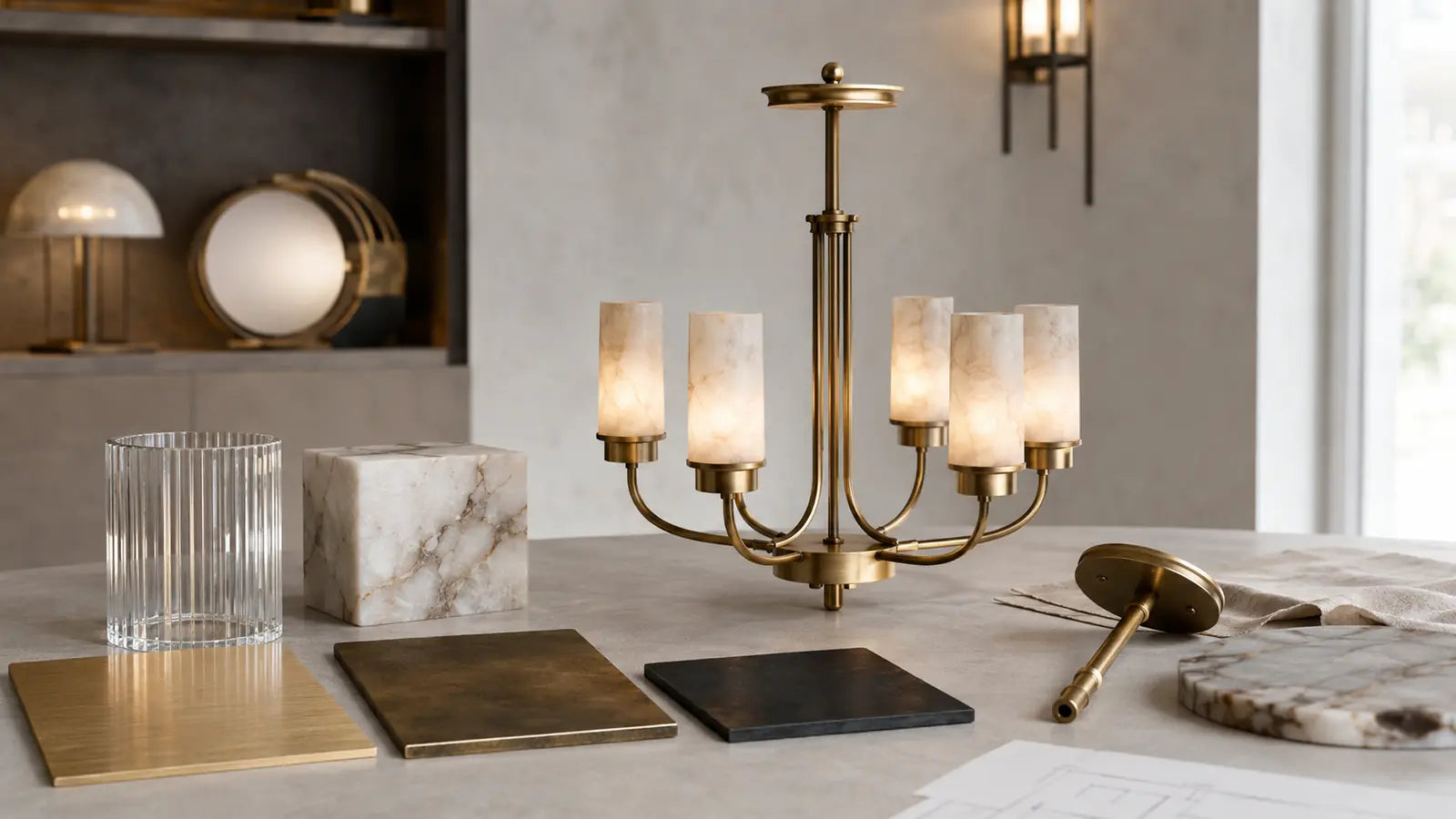
Finish changes can move a light from crisp and contemporary to quiet and aged without changing its basic form. Common directions include brushed brass, polished brass, aged brass, bronze, blackened metal, nickel tones, and painted finishes.
Words are useful, but images are better. If “antique brass” means a soft brown-gold to you, send a photograph. To someone else it may mean a much darker, heavily distressed surface. For projects where the light must sit close to cabinet hardware or architectural metalwork, a finish sample or physical reference may be appropriate.
There will still be normal variation between different materials and production methods. A plated finish, a hand-applied patina, and a painted surface do not age or reflect light in the same way.
Changing the decorative material
Glass, crystal, alabaster, marble, resin, fabric, and other decorative materials each have their own behavior. The question is not only “Can we substitute this?” but also:
- Will the new material transmit, diffuse, or block light differently?
- Is it heavier or more fragile?
- Can it be cut to the required shape and thickness?
- How much natural variation should be expected?
- Does the frame need a new connection detail?
- How will it be protected during shipping and handled during installation?
Replacing glass with alabaster, for example, changes more than color. Stone is heavier, every piece has individual veining, and the light can become softer and more opaque. The result may be beautiful, but it should be designed as a stone fixture rather than treated as a cosmetic swap.
Changing the drop, canopy, or suspension
Ceiling conditions often require their own customization. The suspension can sometimes be adapted with rods, chains, or cables; the canopy may need to change in size, shape, or number of mounting points.
Sloped and vaulted ceilings need particular attention. So do long drops in stairwells, where small differences in ceiling location can affect how the chandelier reads from more than one floor. Share the ceiling angle, mounting point, target lowest point, and any access limits as early as possible.
Changing the light source and controls
Depending on the design, a fixture may use replaceable bulbs or an integrated LED system. Requests for a different color temperature, output, dimming method, or driver location need to be checked against the available internal space and the electrical components used in that configuration.
For a U.S. installation, confirm 110–120V requirements and the intended dimmer or control system. If a project requires a particular certification or specification, it should be discussed for the customized fixture rather than assumed from a similar-looking standard product.
Changes we would question
Customization should solve a room problem or support a clear design direction. We may challenge a request when it creates one of these issues:
- a size that overwhelms the table or leaves unsafe clearance;
- a long unsupported span that needs a different structure;
- a heavier material on a frame not designed for the load;
- too little space for the requested driver, wiring, or lamp;
- a finish expectation that conflicts with the natural character of the material;
- a crate or assembled section that cannot reach the installation area.
That is not a refusal to customize. It is the point of doing the technical review before production. Often there is a better route: divide the frame into installable sections, alter the suspension, use a thinner stone profile, or adjust the spacing while preserving the overall idea.
Three realistic examples
A dining chandelier under a lower ceiling
The diameter may be appropriate, but the standard body and chain create too much drop. Instead of flattening every detail, we can review a shorter suspension and a shallower arrangement while keeping enough space for wiring and visual balance.
A foyer fixture enlarged from a product image
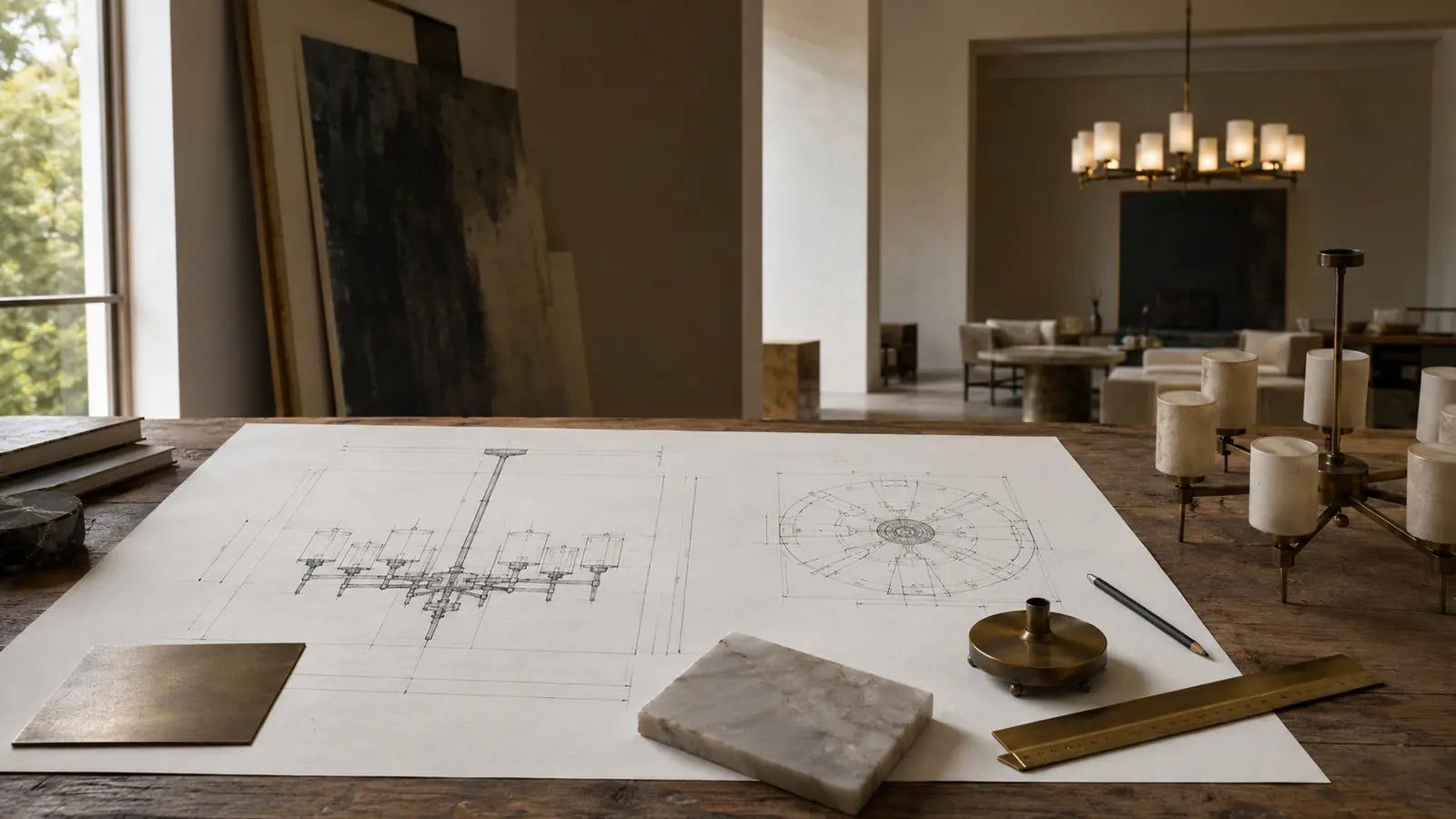
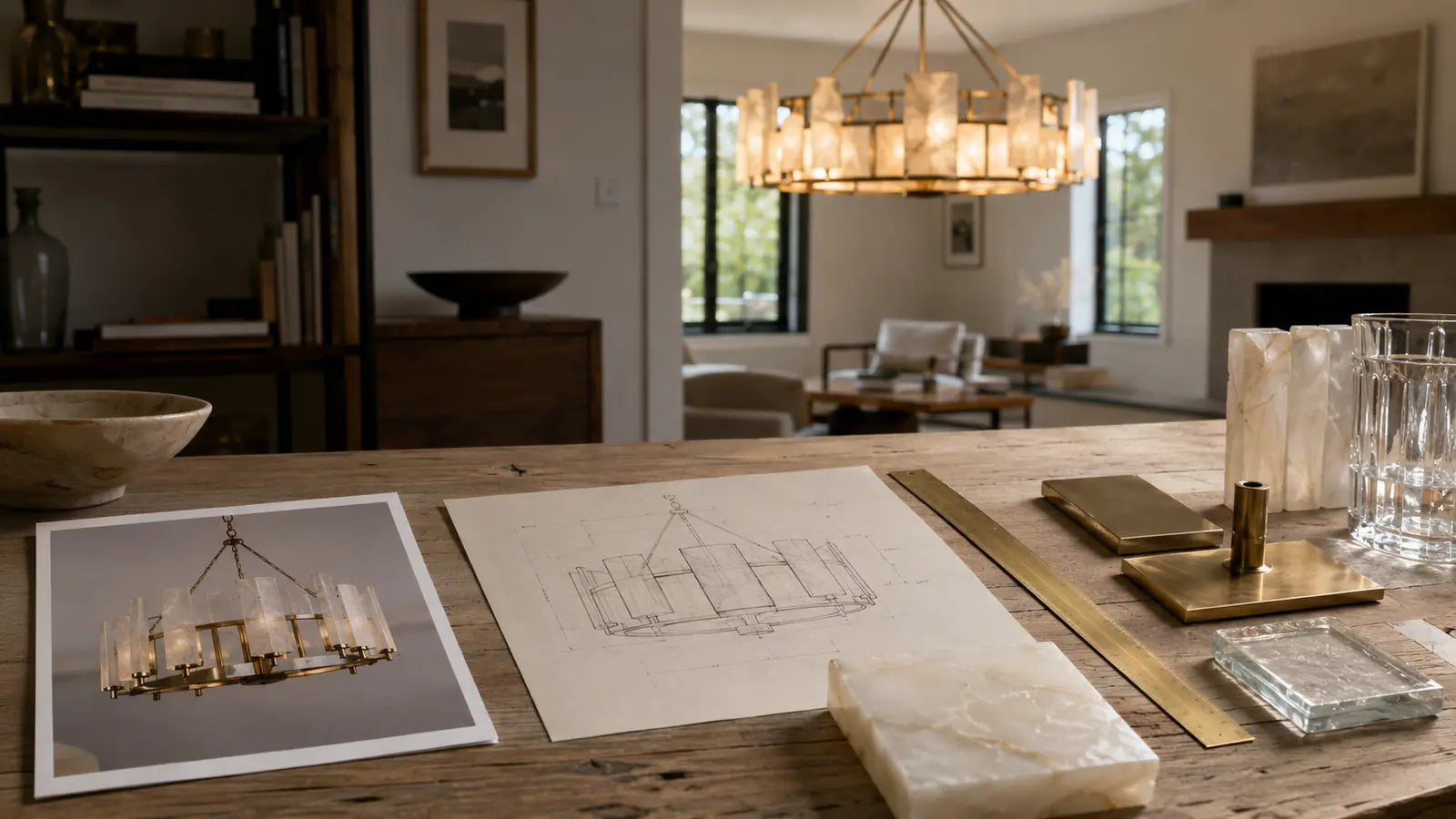
Increasing width and height may require a new frame, additional suspension, a larger canopy, and a sectional assembly plan. The decorative components may also need new spacing so the enlarged fixture does not look sparse.
A brass fixture coordinated with interior hardware
A reference sample can guide the finish direction, but lighting, surface texture, and base material will affect the final appearance. Reviewing the fixture finish next to the room materials is more reliable than choosing from a color name alone.
What to confirm before production
The approved information should include overall dimensions, drop, canopy and suspension, materials, finish direction, light source, color temperature, voltage, dimming requirements, quantity, and any project-specific technical notes. For a complex piece, review an annotated drawing or CAD drawing rather than relying on the original product photograph.
A customized chandelier should feel as though it was meant for the room—not merely stretched, recolored, or fitted with different parts.
To discuss size, finish, material, or electrical changes, send us your reference and room details. It is fine if some choices are still open; we can identify which decisions need to come first.