Factory-Direct Custom Marble Linear Chandeliers for Dining Tables and Kitchen Islands
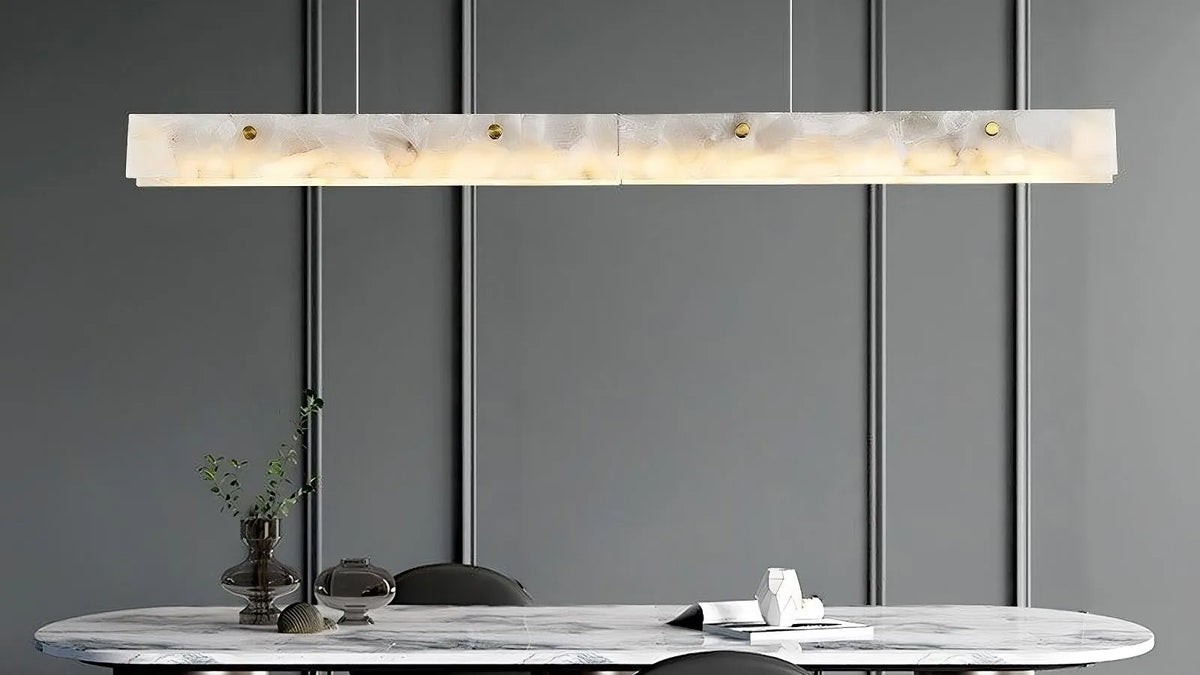
A factory-direct custom marble linear chandelier is a strong choice when a dining table, kitchen island, bar counter, or long reception table needs lighting that feels architectural rather than decorative only. Natural marble gives a softer glow than exposed bulbs, and a linear form helps the fixture follow the length of the furniture below it.
The important point is that a marble chandelier should be planned around the real room. Length, drop, stone thickness, metal finish, color temperature, suspension, weight, and installation access all affect the final result. When you work directly with a custom lighting factory, those details can be reviewed before the chandelier is produced.
Quick answer: when should a marble linear chandelier be custom made?
A factory-direct custom marble linear chandelier makes sense when:
- the dining table, kitchen island, or counter is longer than a standard fixture can cover well;
- the buyer wants natural stone character instead of a plain metal or glass light;
- the project needs a custom length, drop, finish, or color temperature;
- the room has a specific ceiling height, sloped ceiling, or off-center junction box;
- the fixture must coordinate with other lighting in a villa, hotel, restaurant, or residential project;
- the buyer needs drawings, packing details, and installation guidance before shipment.
For a small table or simple room, a standard pendant may be enough. For a long island, formal dining table, hotel dining area, or custom interior project, a made-to-order linear chandelier often looks more intentional.
Custom marble linear chandelier planning checklist
| What to confirm | Why it matters | What to send |
|---|---|---|
| Table or island length | The chandelier should relate to the furniture below it, not only the room size. | Length, width, and height of the table, island, bar, or counter. |
| Fixture length and width | A linear chandelier that is too short can look weak; one that is too long can crowd the ends. | Target fixture length, reference image, and preferred visual coverage. |
| Hanging height | The lowest point must leave comfortable sightlines and enough clearance for daily use. | Ceiling height, tabletop height, desired drop, and room photos. |
| Stone tone and texture | Natural marble varies in veining, translucency, and warmth. | Sample preference, reference photos, and whether you want strong or subtle veining. |
| Metal finish | Brass, bronze, black, and nickel all change the mood of the marble. | Interior hardware photos, finish direction, and other lighting finishes in the project. |
| Electrical details | Voltage, dimming, color temperature, driver access, and light source should be confirmed early. | Country or voltage, dimming system, Kelvin preference, and installer requirements. |
Why linear chandeliers work over dining tables and kitchen islands
A round chandelier can look beautiful over a round table or square room. A long table or kitchen island usually needs a different rhythm. A linear chandelier spreads the visual weight and light across the furniture, so the room does not feel like all the focus is stuck in the center.
For a dining table, the fixture should create atmosphere without blocking conversation. For a kitchen island, it may need to support preparation, serving, and casual seating. For a restaurant or hotel dining area, it may need to repeat across several tables or coordinate with other decorative fixtures.
This is where factory-direct customization helps. The chandelier length, number of stone sections, suspension points, canopy style, and light source can be reviewed together. A standard fixture might be close, but a custom linear chandelier can be built to the exact scale of the table or island.
Natural marble is not a perfectly uniform material
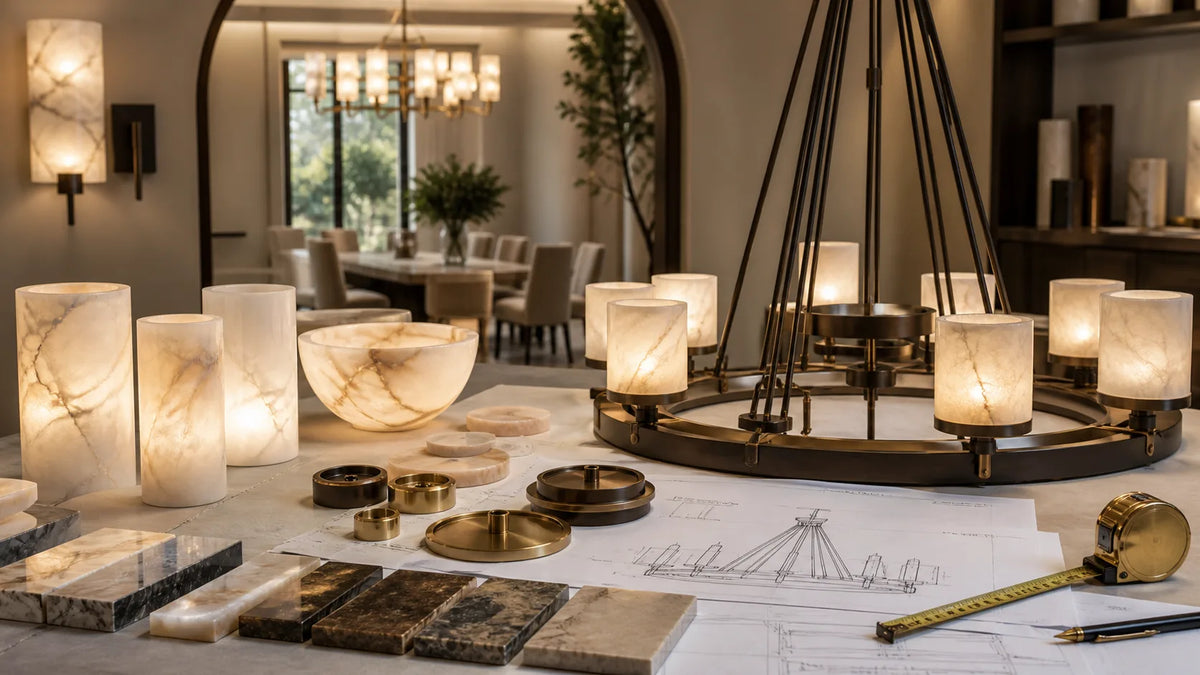
Marble is chosen because it has natural character. Veining, clouding, tone, and translucency can vary from piece to piece. In lighting, that variation becomes more visible because the stone is illuminated from within or near the surface.
A buyer should not expect every section of a marble chandelier to look identical. Some pieces may be warmer, some may be cooler, and some may have stronger veins. A custom lighting factory can review the general material direction, but natural stone cannot be controlled like painted metal or molded acrylic.
For high-end dining rooms, villas, hotels, and restaurants, this natural variation can be a strength. It makes the fixture feel less generic. The key is to agree on the preferred direction before production: cleaner stone, stronger movement, warmer tone, softer diffusion, or more dramatic veining.
Marble, alabaster, and glass: which is right?
Marble and alabaster are both natural stone materials, but they are not the same. Alabaster is often used when the buyer wants a warmer, softer glow and a more translucent stone effect. Marble can feel more architectural and graphic, especially when the veining is visible in a long linear fixture.
Glass is different again. It can be clearer, lighter, brighter, or more reflective. Glass may work better when the fixture needs more sparkle or transparency. Marble is usually chosen when the project wants a heavier natural material feeling and a calmer light effect.
If you are comparing materials for a custom chandelier, our guides to alabaster vs. glass chandeliers and custom alabaster chandeliers may help clarify the difference before requesting a quote.
How to size a marble linear chandelier
The chandelier should be sized from the furniture and the room together. A useful starting point is to choose a fixture that feels long enough to relate to the table or island, while leaving breathing room at both ends. The exact proportion depends on the furniture length, room width, ceiling height, and visual weight of the marble.
Because marble can feel substantial, a slightly restrained size may look better than an oversized one. If the stone is thick, strongly veined, or mounted in a heavy metal frame, the fixture may appear larger than its measurement suggests. If the design is slim and minimal, it may need more length to feel balanced.
For dining rooms, also confirm the hanging height. Many chandeliers above dining tables are positioned so the lowest point sits comfortably above the tabletop, but the final height should be checked with the fixture body, stone thickness, and sightlines. For kitchen islands, task use and head clearance may require a different decision.
Factory-direct customization options
When ordering directly from a custom lighting manufacturer, buyers can often review more than the product length. Depending on the design, a marble linear chandelier may support customization in:
- overall length, width, height, and drop;
- number and size of marble sections;
- stone tone, veining direction, thickness, and diffusion level;
- metal finish, including brass, antique brass, bronze, black, nickel, or custom finish direction;
- ceiling canopy length, shape, and mounting method;
- rod, cable, or chain suspension;
- color temperature, voltage, dimming, and light source direction;
- packing method and installation sequence.
These choices should not be treated separately. Changing the stone size can change weight. Changing the drop can affect suspension. Changing the finish may affect how warm or cool the fixture feels. Good factory-direct custom lighting is about coordinating the whole fixture, not changing one option in isolation.
Color temperature and dimming
Natural marble usually looks best with warm or warm-white light. For many residential dining rooms and villas, 2700K creates a warmer evening mood. For modern kitchens, islands, and clean interiors, 3000K is often a practical balance. Some commercial spaces may consider 3500K or 4000K, but cooler light should be reviewed carefully because it can change the feeling of the stone.
Dimming is useful for dining rooms, kitchen islands, restaurants, and hospitality spaces because the same fixture may need different moods at different times. The dimming method should match the driver, light source, voltage, and project control system.
For more detail, see our guide to custom chandelier color temperature.
Weight, support, and installation
Marble is heavier than many common lighting materials. A slim fixture may be manageable, but a long marble linear chandelier with multiple stone sections needs proper support. The ceiling condition, junction box, canopy, suspension points, and installer access should be reviewed before production.
Ask early:
- What is the estimated finished weight?
- Does the ceiling need extra support or structural review?
- Will the chandelier ship in one piece or sections?
- How are the marble parts protected and labeled?
- What installation notes will be provided before shipment?
- Can the light source or driver be serviced later?
These questions are not extra complications. They are part of making sure the chandelier is buildable, shippable, and usable after installation.
What to send for a factory-direct marble chandelier quote
To receive a useful quote, send the custom lighting factory information that describes both the fixture and the room:
- project type, such as dining room, kitchen island, hotel, villa, restaurant, bar, or reception area;
- table, island, or counter length and width;
- ceiling height and current junction-box position;
- preferred fixture length, drop, and style reference;
- preferred marble tone, veining strength, and metal finish;
- color temperature, voltage, and dimming requirements;
- photos, drawings, or interior renderings if available;
- quantity, timeline, delivery location, and installation access limits.
If you only have a room photo and a reference image, that is enough to start the conversation. The factory can help identify which measurements and technical details are still needed before production.
FAQ
Can a marble linear chandelier be customized for a long dining table?
Yes. Length, drop, stone section size, metal finish, canopy, suspension, light source, and color temperature can often be customized. The final specification should be reviewed against the table size, ceiling height, weight, and installation conditions.
Is marble too heavy for a chandelier?
Marble can be heavier than glass, acrylic, or fabric shades. That does not mean it cannot be used, but ceiling support, canopy design, suspension, packing, and installation should be reviewed early, especially for large fixtures.
Is a linear chandelier better for a kitchen island?
A linear chandelier often works well over a kitchen island because it follows the length of the counter and spreads light more evenly. The best size depends on island length, ceiling height, seating, task use, and the visual weight of the fixture.
Can a factory match the marble pattern exactly?
Natural marble cannot be matched exactly. A factory can review general stone tone, veining direction, and selection standards, but variation should be expected. Buyers should confirm the preferred material direction before production.
What color temperature is best for a marble chandelier?
2700K and 3000K are common choices. 2700K feels warmer and more atmospheric, while 3000K gives a cleaner warm-white look. Cooler color temperatures should be reviewed carefully because they can change how the stone appears.
A factory-direct custom marble linear chandelier should feel made for the room, not only selected from a catalog. When size, stone, finish, light source, support, packing, and installation are reviewed together, the result is more reliable. If you are planning a dining table, kitchen island, hotel, villa, restaurant, or bar lighting project, our custom lighting process can help turn the room details into a buildable chandelier proposal.