How to Choose the Right Chandelier Size for a Dining Table
The safest starting point is simple: choose a dining room chandelier that is about one-half to two-thirds the width of the table, then confirm the hanging height, ceiling height, fixture shape, and sightlines in the actual room. For most dining tables, the bottom of the chandelier sits about 30 to 36 inches above the tabletop, but tall ceilings, large fixtures, and multi-tier designs may need a different drop.
That rule is useful, but it is not the whole decision. A chandelier that is technically the right width can still feel wrong if the arms are too dense, the shades sit too low, the canopy is off-center, or the fixture blocks the view across the table. Good sizing is a balance between measurement, proportion, light output, and how people actually use the room.
Quick sizing answer
If you need a first estimate before asking for a custom quote, use this checklist:
- Start with a chandelier width around one-half to two-thirds of the table width.
- For long rectangular tables, consider a linear chandelier or a longer oval form instead of a compact round fixture.
- Keep the bottom of the fixture around 30 to 36 inches above the tabletop in many standard dining rooms.
- Leave comfortable visual clearance so people can see each other across the table.
- Check the ceiling box, canopy location, fixture weight, and support before production or installation.
For custom lighting, these numbers are a starting point for discussion, not a substitute for reviewing the room. A drawing, table size, ceiling height, and a few photographs help turn the estimate into a fixture that looks intentional.
Dining table chandelier size guide
The table is usually the best anchor for chandelier width because the fixture should feel related to the furniture below it. The room matters too, but if the chandelier is dramatically wider than the table, it can feel awkward and may create clearance problems around the seating area.
| Dining table size | Useful chandelier direction | What to check before ordering |
|---|---|---|
| Round table | A round, globe, ring, or compact branching chandelier usually works well. | Confirm that the fixture is centered over the table, not only centered in the room. |
| Rectangular table | A linear, oval, or elongated chandelier often feels more proportional. | Check the fixture length against the table length and chair movement at both ends. |
| Long dining table | One long chandelier or two coordinated fixtures may be better than one small central light. | Review electrical box placement, symmetry, and whether extra ceiling support is needed. |
| Narrow table | A slimmer fixture can preserve sightlines and reduce visual crowding. | Check shade diameter, arm spread, and distance from seated guests. |
How high should a chandelier hang above a dining table?
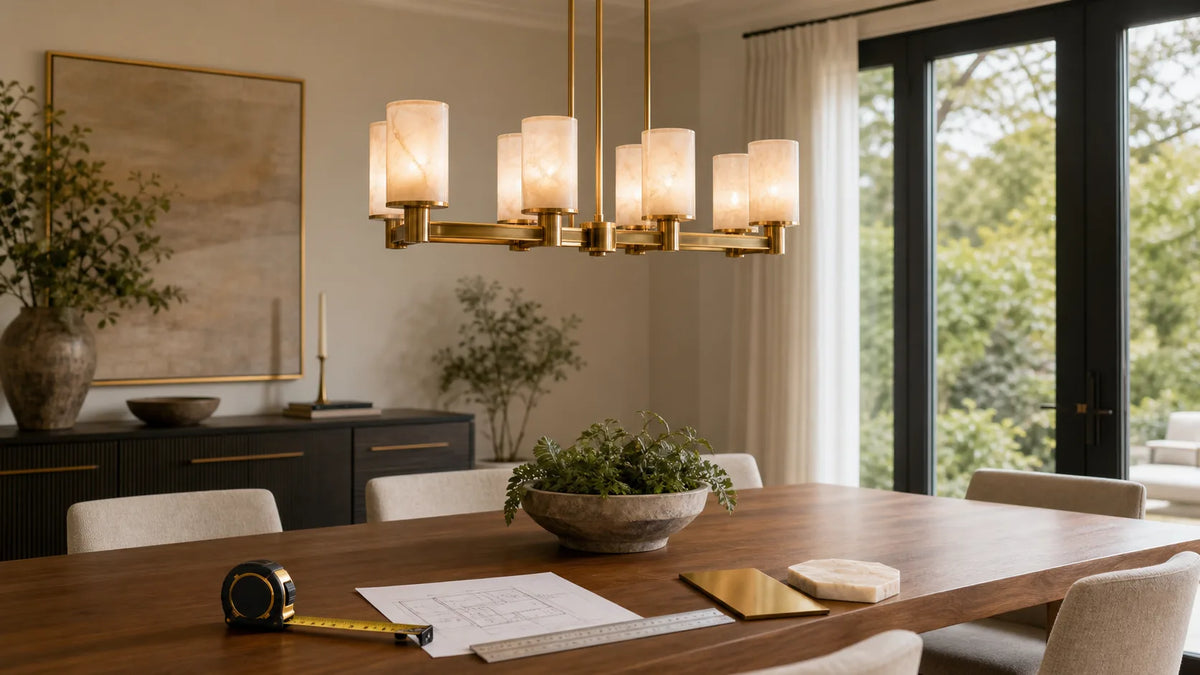
In many dining rooms, the bottom of the chandelier is placed about 30 to 36 inches above the tabletop. This gives the fixture presence without making it feel like an obstacle. The measurement should be taken from the tabletop to the lowest point of the fixture, including crystals, glass, stone diffusers, decorative drops, or the bottom edge of a shade.
There are situations where the height should be adjusted. A tall ceiling may allow a slightly higher position so the chandelier fills the vertical space. A heavy multi-tier fixture may need more breathing room. A very minimal linear chandelier may sit lower if it does not block faces or views. The best test is practical: sit at the table and imagine conversation, serving dishes, flowers, and movement around the room.
Why table width is only the first step
Two chandeliers can have the same width and feel completely different. A thin brass ring, a dense crystal chandelier, and a multi-arm alabaster fixture may all measure 40 inches wide, but their visual weight is not the same. That is why custom sizing should consider both physical dimensions and visual density.
When we review a custom chandelier for a dining table, we usually look at:
- overall width, length, and fixture-body height;
- overall drop from ceiling to the lowest point;
- table width, table length, and seating layout;
- ceiling height and ceiling-box position;
- canopy size, rod length, chain length, or cable suspension;
- material weight, especially for stone, thick glass, or large metal frames;
- brightness, dimming needs, and whether the light should be decorative or functional.
Common sizing mistakes
Choosing by room size only
Room size is helpful, but the chandelier belongs visually to the table. A large dining room with a modest table may not need a huge fixture. A smaller room with a long table may need an elongated design to avoid looking under-scaled.
Ignoring the lowest point
Many chandeliers have decorative details below the main frame. If the lowest crystal, glass shade, or alabaster piece sits too low, the fixture may interrupt the view across the table even when the frame height looks acceptable.
Forgetting the canopy
The ceiling canopy affects alignment, suspension, and installation. If the electrical box is not centered over the table, the fixture may need a longer canopy, custom plate, swag solution, or a ceiling adjustment by the project team.
Assuming bigger always looks more luxurious
Scale matters, but oversized lighting can make a dining room feel crowded. A custom chandelier should look generous without fighting the architecture, furniture, or people seated below it.
What to send for a custom chandelier size recommendation
You do not need a full design package to begin. For a useful sizing suggestion, send the information that defines the space:
- table width, length, and height;
- ceiling height above the table;
- room dimensions if available;
- photos taken from several angles;
- the current or planned ceiling-box location;
- reference images showing the chandelier style you like;
- any finish direction, such as brass, blackened metal, glass, crystal, alabaster, or mixed materials.
These details help us suggest a fixture width, length, drop, suspension method, and material direction before preparing a more detailed custom lighting proposal.
FAQ
What size chandelier should go over a dining table?
A practical starting point is a chandelier that is about one-half to two-thirds the width of the dining table. For rectangular tables, also compare the chandelier length with the table length so the fixture does not look too small in the center.
How far above a dining table should a chandelier hang?
Many dining room chandeliers hang with the lowest point about 30 to 36 inches above the tabletop. The exact height depends on ceiling height, fixture shape, visual density, and whether the chandelier blocks views across the table.
Can a dining chandelier be customized to fit my table?
Yes. Width, length, drop, finish, materials, and suspension details can often be customized. The important step is reviewing the table, ceiling height, support conditions, electrical requirements, and desired style together.
Is one chandelier or two better for a long dining table?
For a long table, one elongated chandelier or two coordinated fixtures may look more balanced than one compact central chandelier. The better choice depends on table length, ceiling-box placement, fixture style, and the rhythm of the room.
Choosing the right dining chandelier size is partly measurement and partly judgment. If you are planning a custom fixture, share the table dimensions, room photos, ceiling height, and reference images. We can help translate those details into a chandelier size, drop, and material direction that fits the room before production begins.